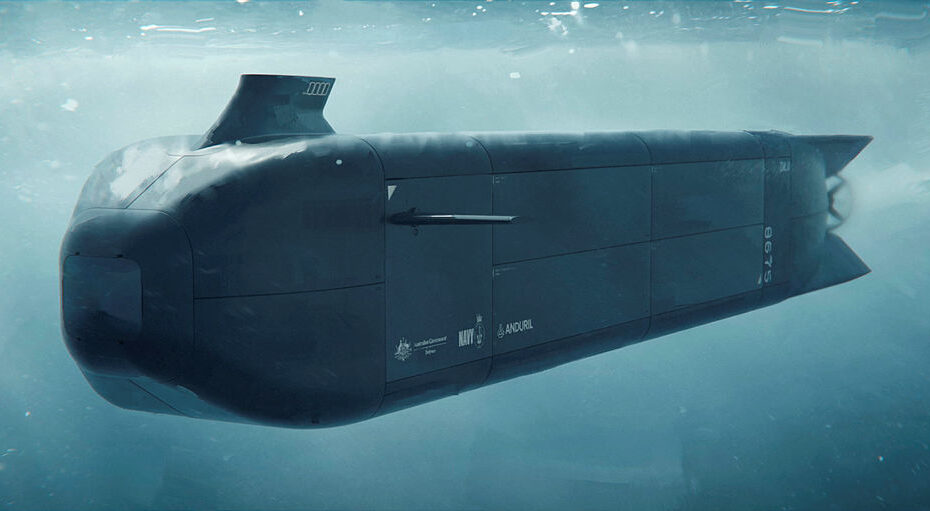
Ghost Shark ‘Alpha’ is the first of three prototypes being co-developed by the Defence Science and Technology Group, the Royal Australian Navy and Anduril Australia. Ghost Shark will provide the Royal Australian Navy with a stealthy, long-range autonomous undersea warfare capability that can conduct persistent intelligence, surveillance, reconnaissance and strike. The Ghost Shark will form part of the Albanese Government’s investment of up to $7.2 billion for the development and acquisition of subsea warfare capabilities and new autonomous and uncrewed maritime vehicles. (Credit: Australian Department of Defence)
Australia awarded Anduril a $1.7 billion production contract for Ghost Shark extra-large autonomous underwater vehicles on September 10, 2025. Seven weeks later, the company opened a 7,400-square-meter manufacturing facility in Sydney. First production delivery: January 2026.
That’s concept to production in under four years for an Australian-manufactured autonomous undersea capability built on Australian soil. For comparison, the SSN-AUKUS preliminary design review doesn’t happen until September 2026. The first Australian nuclear submarine won’t hit water until the 2040s.
So the question isn’t whether Australia can execute rapid maritime autonomy procurement. Ghost Shark proved that. The question is what comes next, which companies are positioned to win follow-on contracts, and whether AUKUS Pillar 2 can replicate this success, or if Ghost Shark remains the exception that proves traditional acquisition still rules.
The Ghost Shark Template vs Traditional Acquisition
Ghost Shark demonstrates what AUKUS Pillar 2 was designed to enable: rapidly delivering capability by skipping traditional defense acquisition timelines entirely. Anduril took significant development risk with its own capital before government funding arrived. The Australian government responded with an accelerated procurement pathway that bypassed the usual systems design and development phase.
No five-year requirements definition. No endless design reviews. Prototype, test, produce.
May 2022: co-development contract ($140 million AUD). 2025: three prototypes delivered ahead of schedule and on budget. September 2025: full production contract. October 2025: operational manufacturing facility. January 2026: first production delivery.
The Sydney facility is positioning for allied export. Subject to approvals, Anduril is building capacity to produce vehicles for the US Navy and other Indo-Pacific partners. The AUKUS template for maritime autonomy is scaling beyond the original trilateral partnership.
Compare that to Boeing’s Orca program for the US Navy. Initial contract in February 2019, with options totaling $274.4 million for five vehicles. The first test asset was delivered in December 2023, over three years late. The program has consumed approximately $885 million according to Government Accountability Office reporting, and it remains unclear whether the Navy will transition Orca to a program of record.
Traditional prime. Traditional acquisition pace. Traditional cost overruns and schedule slips.
Ghost Shark and Orca are both funded government programs, so neither is a startup burning VC cash hoping for a contract. But the timelines and execution tell you which procurement model works when you need capability this decade rather than next.
Australia’s Positioning Problem and Opportunity
Here’s the strategic context most coverage misses. Singapore’s Defence Science and Technology Agency signed an MOU with Korean Register on January 7-8, 2026, focused on verification and validation frameworks for autonomous maritime systems. Standards aren’t bureaucracy. They’re market gatekeepers. The country that develops credible verification methods first becomes the certification authority everyone else references.
Norway did this in Europe starting in 2018. The Yara Birkeland has completed 175+ autonomous cargo voyages since 2022, currently operating with a reduced crew with fully unmanned operation targeted by 2028. Four additional autonomous ferries are under contract. Singapore is positioning itself to do the same thing for the Asia-Pacific.
Australia has a window here. Ghost Shark production creates operational data. AUKUS Pillar 2 provides the trilateral framework for shared standards development. The Maritime Innovation Challenge launched in March 2025 with approximately $8-9 million in funding across the three nations, specifically targeting undersea communications and autonomous systems control.
If Australia leverages Ghost Shark operational experience into standards development through AUKUS working groups, it positions itself upstream in Indo-Pacific maritime autonomy rather than downstream as a customer. That’s the Pillar 2 promise: Australia as innovation partner, not just procurement partner.
But the window is narrow. Singapore is moving fast. The US Coast Guard lacks statutory authority to waive crew requirements for commercial vessels—the Government Accountability Office made this explicit in August 2024. US commercial operators wait until 2032 for international regulatory harmonization, while Singapore enables operational deployments by 2027-2028.
Australia sits somewhere between. Defence operates autonomous systems under sovereign immunity. Commercial operators face US-like regulatory ambiguity. Lacking clear pathways for deployment, Australian dual-use companies (Marine Instruments, Advanced Navigation) compete with Singapore-based operators on uneven regulatory ground.
Standards development through AUKUS Pillar 2 could solve this. Trilateral verification frameworks become de facto Asia-Pacific standards. Australian companies get early regulatory clarity. Singapore and Norway move faster on purely domestic frameworks, but AUKUS standards carry more weight because they’re backed by three allied navies rather than one jurisdiction’s experimental programs.
That’s the strategic play. Whether Australia executes it determines which companies win in the next 24 months.
What’s Coming for Australian Defence Procurement
Anduril Ghost Shark production ramps through 2026-2027, with first vehicle delivery this month and fleet buildup continuing. The Sydney facility is operational. The question is volume. How many vehicles does the Royal Australian Navy actually procure? What’s the timeline for follow-on orders?
The $1.7 billion contract covers an initial fleet, but allied export potential matters more long-term. If the US Navy adopts Ghost Shark variants (subject to export approvals and US procurement processes), Anduril’s Sydney facility becomes an allied production hub. That changes the economics entirely. You’re not just serving Australian defence needs. You’re serving Indo-Pacific allied navies through AUKUS industrial cooperation.
Huntington Ingalls Industries announced in December 2025 that ROMULUS prototype construction reached 30% completion, with sea trials scheduled for Q4 2026. ROMULUS is a modular, AI-enabled family of unmanned surface vessels designed for the US Navy, Marine Corps, and allied customers. The autonomy software is Odyssey, already deployed on 35+ unmanned surface platforms and over 750 REMUS underwater vehicles worldwide.
In December 2025, Babcock International confirmed plans to integrate ROMULUS into the Royal Navy’s ARMOR Force concept. This is AUKUS Pillar 2 working as intended: UK accessing US-developed systems through industrial partnership rather than 10-year joint development programs.
What does Australia get from this? Potentially access to proven US large USV capability through AUKUS frameworks rather than developing domestic alternatives from scratch. That only works if Australia participates in requirements definition and industrial workshare. If ROMULUS becomes a US-UK program with Australia as a customer, that’s Pillar 1 dynamics (downstream procurement) applied to Pillar 2 systems.
The alternative: Australian companies developing domestic large USV capability. Marine Instruments and Advanced Navigation both serve defense and commercial markets. Smaller scale than Saildrone or Ocean Infinity, but profitable operations in dual-use markets. If they can scale with Australian defence contracts, they position for broader Indo-Pacific sales to allied navies.
The procurement decision matters. Ghost Shark shows Australia can execute rapid domestic capability development. ROMULUS integration shows Australia can leverage allied systems through AUKUS frameworks. Which path Australian defence chooses for large USVs determines whether domestic industry scales or remains niche.
AUKUS Maritime Innovation Challenge Stage 2 contracting is underway as of November 2025. $8-9 million across three nations supporting 3-10 proposals focused on undersea communications and autonomous systems control. Not large dollar amounts, but directionally important for identifying which companies solve cross-domain coordination problems.
Single-platform autonomy is commodity technology. One USV doing ISR? Solved problem. The operational concept defence actually cares about is distributed networks of autonomous platforms coordinating across domains without constant human intervention. Companies proving this works in AUKUS trials position for follow-on production contracts.
Who Wins in Australian Supply Chain
Anduril has a production contract and operational facility. They win unless they fail to deliver, which seems unlikely given their track record of hitting prototype deadlines.
Marine Instruments and Advanced Navigation compete for Australian defence contracts serving both defense and commercial ocean science. Lower profile than US competitors, but profitable niche operations with domestic manufacturing. If Australian defence prioritizes domestic capability development, these companies are positioned. If Australia leverages AUKUS frameworks to access US systems at scale (ROMULUS, potentially Saildrone for ISR), domestic companies remain niche suppliers for specialized payloads and sensors rather than prime platform providers.
Saildrone and Ocean Infinity operate globally but have demonstrated AUKUS alignment. Saildrone partnered with Thales Australia on towed-array sonar integration. Ocean Infinity runs the Armada fleet for offshore energy and defence contracts. Both are positioned for Australian procurement if domestic capability development isn’t prioritized.
Traditional primes (Huntington Ingalls, General Dynamics, Lockheed Martin) compete through AUKUS industrial cooperation. HII ROMULUS heading to sea trials in Q4 2026 positions them for Australian consideration if large USV procurement follows proven systems rather than developmental domestic alternatives.
The business model distinction matters for materials investors watching this space. Dual-use companies (Saildrone, Ocean Infinity, Marine Instruments) have the lowest existential risk. Defence contracts fund R&D and prove operational capability. Commercial customers provide volume. When ocean materials operations scale to the point of justifying autonomous monitoring (likely 2028-2032, depending on jurisdiction), these companies can add that revenue stream without threatening core business survival.
Pure defence plays (Anduril underwater, Saronic) won’t pivot to kelp monitoring. Margins are too thin, customers are too small, and the mission set is incompatible with exquisite naval platforms designed for kinetic operations in contested environments.
The OTI Take
Ghost Shark proves AUKUS Pillar 2 can deliver capability this decade when procurement follows the Anduril model: commercial capital funds rapid development, proven prototypes win accelerated government contracts, production begins immediately. The question is replication.
If Australian defence applies the Ghost Shark template to large USVs—rapid prototyping, commercial partnerships, accelerated procurement—domestic industry scales. If Australia defaults to traditional acquisition or leverages AUKUS frameworks to access US systems as a customer, domestic companies remain niche.
Singapore is building verification frameworks for the deployment of commercial autonomous systems by 2027-2028. Norway already operates autonomous cargo vessels commercially. Australia has operational Ghost Shark data and AUKUS trilateral cooperation for standards development. The strategic play is leveraging that into Asia-Pacific certification authority positioning, not waiting for 2032 international harmonization.
The next 24 months determine whether Australia leads autonomous maritime systems in the Indo-Pacific or follows proven technology developed elsewhere. Ghost Shark gives Australia credibility. What comes next determines whether that credibility compounds into a sustained capability advantage or remains an impressive one-off in a portfolio of traditional procurement.
The above analysis draws from comprehensive research tracking 15+ unmanned maritime systems companies, regulatory timelines across jurisdictions, and the intersection of defence procurement with commercial ocean materials operations. The full Deep Dive, including company-by-company analysis, cross-domain coordination capabilities, and materials convergence timeline, is available at Ocean Tech Intelligence.
Author Mick
Mick publishes Ocean Tech Intelligence, a weekly strategic analysis newsletter covering maritime autonomy and regenerative ocean materials with a focus on AUKUS and Indo-Pacific defense procurement. Based in Adelaide, Mick analyzes the intersection of defense technology development and sustainable ocean industries. Subscribe at oceantechintelligence.com today!