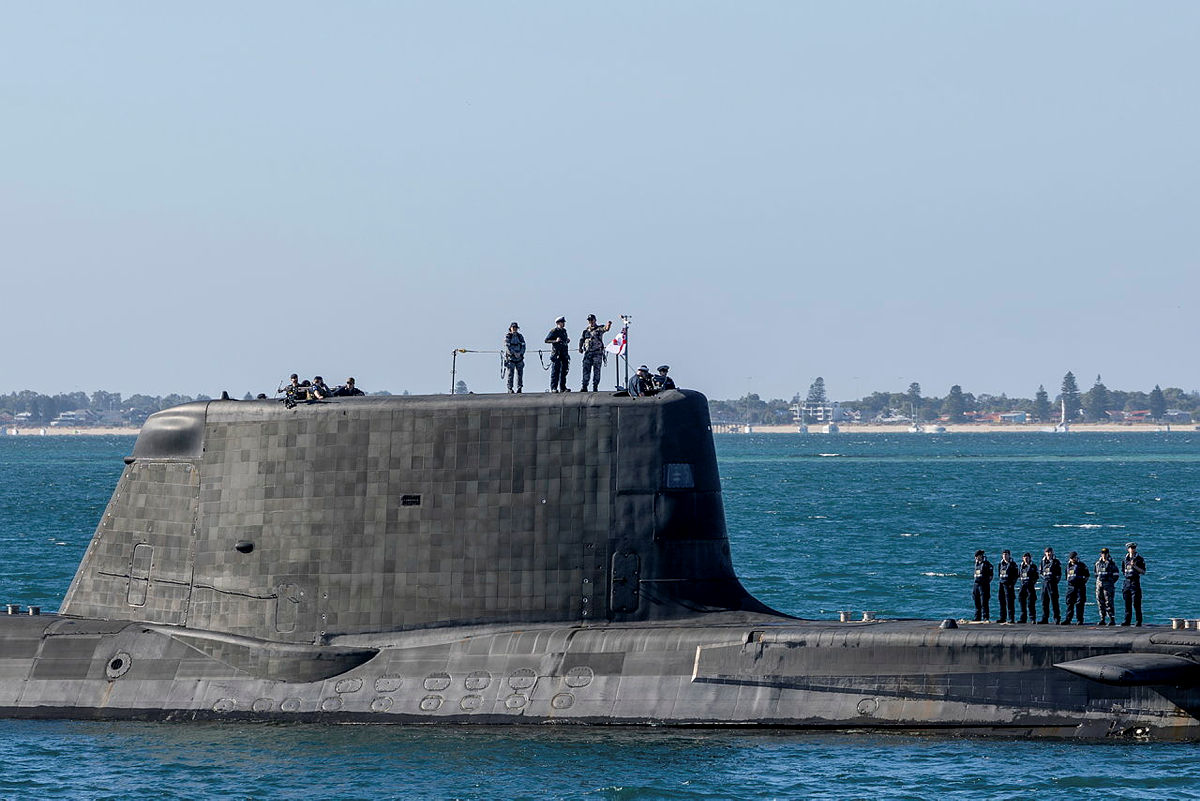
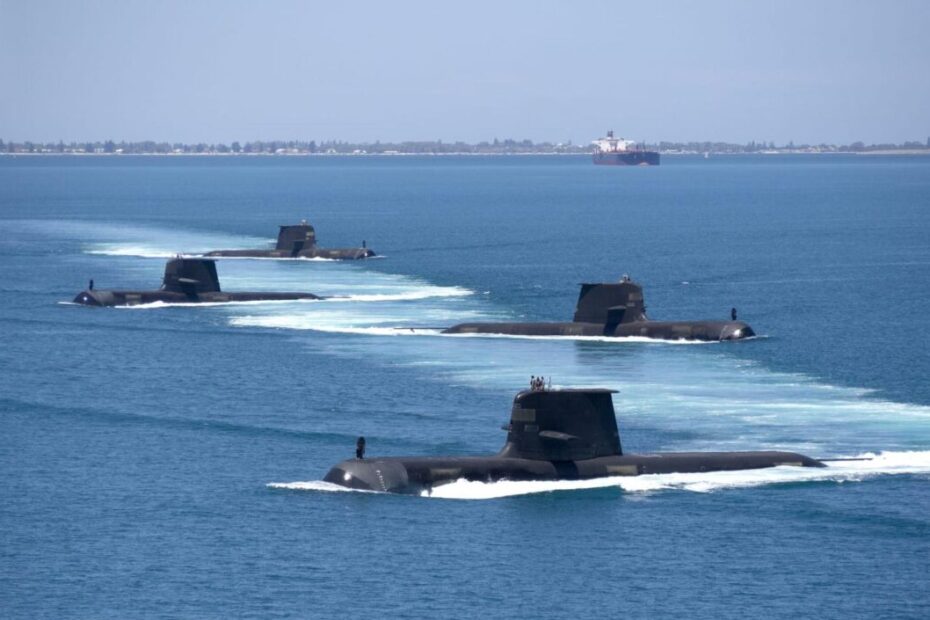
Australian Collins class submarines transiting through Cockburn Sound, Western Australia, which will be an expanded base for the new nuclear-powered boats (Chris Prescott/Defence Department)
Australia currently faces two highly concerning outcomes under the current plan for AUKUS Pillar I: a prolonged and dangerous submarine capability gap through the 2030s and into the 2040s, or sustained pressure on the United States (US) to transfer Virginia-class submarines it is struggling to spare from its own Navy.
These outcomes are not abstract risks; they are the logical consequence of concentrating Australia’s future submarine capability within a single, highly constrained external supply chain.
This is not a critique of alliance intent or political commitment, but a sober assessment of force-generation risk under sustained demand. The same strategic conditions that have elevated submarines to the centre of Australia’s defence planning are simultaneously increasing their value and scarcity within allied navies. Virginia-class submarines are no longer discretionary assets; they are among the most heavily contested platforms in US naval planning. In such circumstances, Washington will always prioritise its own force requirements – just as Canberra would do if the roles were reversed.
Since 2022, US Congressional reporting notes that actual Virginia-class submarine production has averaged about 1.2 boats per year, constrained by workforce shortages, supplier bottlenecks, and shipyard capacity limits. Current US planning assumes production can be lifted to two submarines per year by 2028, and then further increased to over 2.3 boats annually to clear the existing order backlog, meet US Navy force requirements, and replace hulls intended for transfer to Royal Australian Navy (RAN) under AUKUS. That uplift ultimately requires not only recovering lost production capacity, but sustaining build rates the US submarine industrial base has not achieved in recent years – leaving no headroom for delay or competing demands.
The recent Pentagon review of AUKUS Pillar I, followed shortly thereafter by the annual AUSMIN meeting, reaffirmed the existing pathway but offered little public clarity on how these industrial constraints will be resolved. Australia has already committed substantial funding into the US submarine industrial base uplift, yet these contributions do not publicly confer delivery guarantees or priority access to scarce production capacity.
As currently structured, the AUKUS submarine “Optimal pathway” offers no meaningful redundancy. It relies on successive life-of-type extensions (LOTE) to the current ageing Collins-class submarine fleet, until Virginia-class transfers in the 2030s, and later, when SSN-AUKUS submarines become available in the 2040s. Should production rates fail to increase as projected, or US strategic requirements tighten further, or Collins LOTE be unsuccessful, Canberra will have no other choice than to wait it out and risk a dangerous capability gap. By concentrating Australia’s future submarine deterrence within a single foreign supply chain, it has created a single point of failure risk.
The logical response, and what has been missing from the current debate, is hedging. The choice facing Australia is too often framed as binary: either push ahead with the existing pathway as planned, or abandon it entirely. A more resilient approach would be to treat the current AUKUS pathway as a contingent option rather than the sole foundation of Australia’s future submarine force. An approach which increases sovereign control while preserving alliance objectives and long-term interoperability with key partners, that also keeps the door open for a future transition to SSN-AUKUS.
Australia requires an alternative submarine pathway.
Given the circumstances, Canberra should adopt a mixed-fleet built around two complementary platforms – the French Suffren-class Nuclear-powered and Conventionally-armed attack submarine (SSN), and the South Korean KSS-III Batch II Conventionally-power and Conventionally-armed attack submarine (SSK).
Former RAN submarine commander Peter Briggs was among the first to publicly argue that Australia should revisit a French nuclear-powered submarine option, in response to increasing doubts about the feasibility of the current AUKUS pathway. This proposal differs in a crucial respect: it does not seek to replace AUKUS altogether, but to hedge within it.
Under this proposed mixed-fleet model, South Korea’s Dosan Ahn Changho-class (KSS-III Batch II) submarines would provide a direct, low-risk replacement for the Collins-class fleet. They retain broadly comparable operating concepts in terms of conventional propulsion, crewing numbers, and mission employment. As a modern submarine it offers advanced capabilities, some otherwise found only on nuclear-powered submarines such as vertical launch system (VLS) with at least 10 launch tubes/cells for land-attack and strike missions. With a crew of 50 and air-independent propulsion, the KSS-III represents a like-for-like conventional capability upgrade rather than a doctrinal leap. Minor, mature design adjustments – such as an X-stern configuration – could further align the platform with existing RAN operations.
France’s Suffren-class submarines would provide the nuclear-powered element of the fleet, delivering sustained presence that conventional submarines cannot. While smaller displacement and slightly lower endurance than US or UK designs, the Suffren-class offers comparable stealth, reach, and mission effectiveness for the RAN, while being cheaper to produce and requiring a much smaller crew (around 65 vs 100/135) to operate. Its optimised profile offers more than enough to meet Australia’s Indo-Pacific operating requirements – especially for intelligence collection and special operations via the use of a mountable dry-deck shelter, and sustained monitoring of key Sea Lines of Communication.
The French low-enriched-uranium (LEU) K-15 reactor design permits refuelling every 10 years during major overhauls, giving Australia greater flexibility in managing service life and hull numbers during transition, rather than being locked into a single life-of-boat core with US and UK designs. The use of LEU also avoids the considerable legal and non-proliferation complications associated with introducing weapons-grade fuel into a non-nuclear-weapon state, removing a major political obstacle. Likewise, this approach also avoids normalising a loophole exception Australia might otherwise object to in others, and strengthens its standing under international law.
Crucially, this hybrid approach enables Australia to diversify production timelines and industrial risk. South Korea could deliver early KSS-III Batch II submarines from its existing mature shipyards, while progressively transferring work to Australia, potentially to Australian Submarine Corporation (ASC) West in Henderson, Western Australia. Hanwha Ocean has indicated that, following contract signature, the first KSS-III could be delivered within six years, with subsequent units produced at roughly twelve-month intervals thereafter. Meanwhile, France’s Suffren production line is already in serial production, with additional export capacity expected to open toward the end of the 2020s as Paris’s domestic orders conclude – enabling opportunity for parallel construction between Cherbourg and ASC in Osborne, Adelaide.
This structure reduces schedule risk, spreads workforce demand, and ensures that delay in one production line does not stall the entire submarine enterprise. It also offers an opportunity to recover value from sunk investment associated with Australia’s previously cancelled Attack-class submarine program, particularly in industrial development at Osborne.
Taken together, a mixed fleet of KSS-III and Suffren submarines delivers more hulls, sooner, at lower cost, with fewer crew. The latter being a decisive advantage given the necessary workforce growth constraints. The comparison table below illustrates the scale of this advantage:
| Current “Optimal Pathway” | Proposed Mixed Fleet | ||||
| Submarine Cost | Number | Crew per boat | Submarine Cost | Number | Crew per boat |
| Virginia Block 5$7.1 billion AUD | 1 | 135 | KSS-III Batch II (built in South Korea + 20% export premium)$1.4 billion AUD | 3 | 50 |
| SSN-AUKUS** (built in UK)$5 billion AUD | 0 | 100+ | Suffren (built in France + 20% export premium)$3.4 billion AUD | 3 | 65 |
| Virginia second hand Block 3 or 4 (TBD)$3-4.5 billion AUD | 2 to 4 | 135 | KSS-III Batch II (+50% built in Australia)$2.1 billion AUD | 3 | 50 |
| SSN-AUKUS** (built in Australia +50%)$7.5 billion AUD | 5 | 100+ | Suffren (+50% built in Australia)$5.1 billion AUD | 3 | 65 |
| TOTAL: $50.6-62.6 billion AUD |
8 to 10 | 905 to 1175 | TOTAL: $36 billion AUD |
12 | 690 |
| Note: These are rough indicative estimates only based on open-source information and should not be considered as fact. **The SSN-AUKUS costing is based on early-stage estimate based on extrapolation from Astute-class costs, which predates new reactor design finalisation, VLS integration, UK-Australia production planning, and nuclear-safety certification. The true cost is likely to be significantly higher. | |||||
Given the scale of investment involved and the strategic consequences of failure, Canberra should urgently investigate this mixed-fleet option and commission a feasibility study.
The 2023 Defence Strategic Review is explicit that the pursuit of perfect solutions must give way to delivering minimum viable capability in the shortest possible time. It also makes clear that conventionally armed, nuclear-powered submarines should be obtained as soon as possible, given they sit at the centre of Australia’s future strategy of denial, long-range strike, and defending its northern approaches. Measured against those criteria, this mixed-fleet approach aligns far more closely with Canberra’s own strategic guidance than the current pathway.
In this context, the mixed-fleet model should be considered as a new Plan A: a lower-risk approach that delivers usable submarine capability sooner, while preventing a single point of failure. Meanwhile SSN-AUKUS submarines should remain a longer-term objective, pursued once Australia has restored industrial depth, workforce capacity, and strategic margin – not as the next step in a fragile capability transition. The current AUKUS approach, reliant on US submarine transfers, should therefore be retained as Plan B: with Virginias treated as a contingency or surge capacity rather than the foundation of Australia’s future submarine fleet.
* Nathaniel England is a doctoral student at the University of Warsaw. His research focuses on the emerging inter-regional nexus between Europe and the Indo-Pacific, analysing the strategic convergence of these theatres across security and other dimensions. He has previously lectured on Indo-Pacific geopolitics at Civitas University in Poland, where he also completed a master’s degree specialising in International Security Studies.
Republished with the permission of Nathaniel England with an original article link here.